Author: admin

  • blue eyes

    blue eyes

    Album

    19.10. , 20.10.

    I liked Peru from the first moment. The first two female officers I met at the border gave me compliments for my beautiful blue eyes. 🙂

    I spent the first two nights in Máncora on the coast. It’s time again to have my laundry done. In the hostel they want me to fill out a piece of paper, with the amount of different pieces in the plastic bag. I don’t want to unpack and count my clothes so I wrote on the paper: “almost everything I have.”

    21.10.

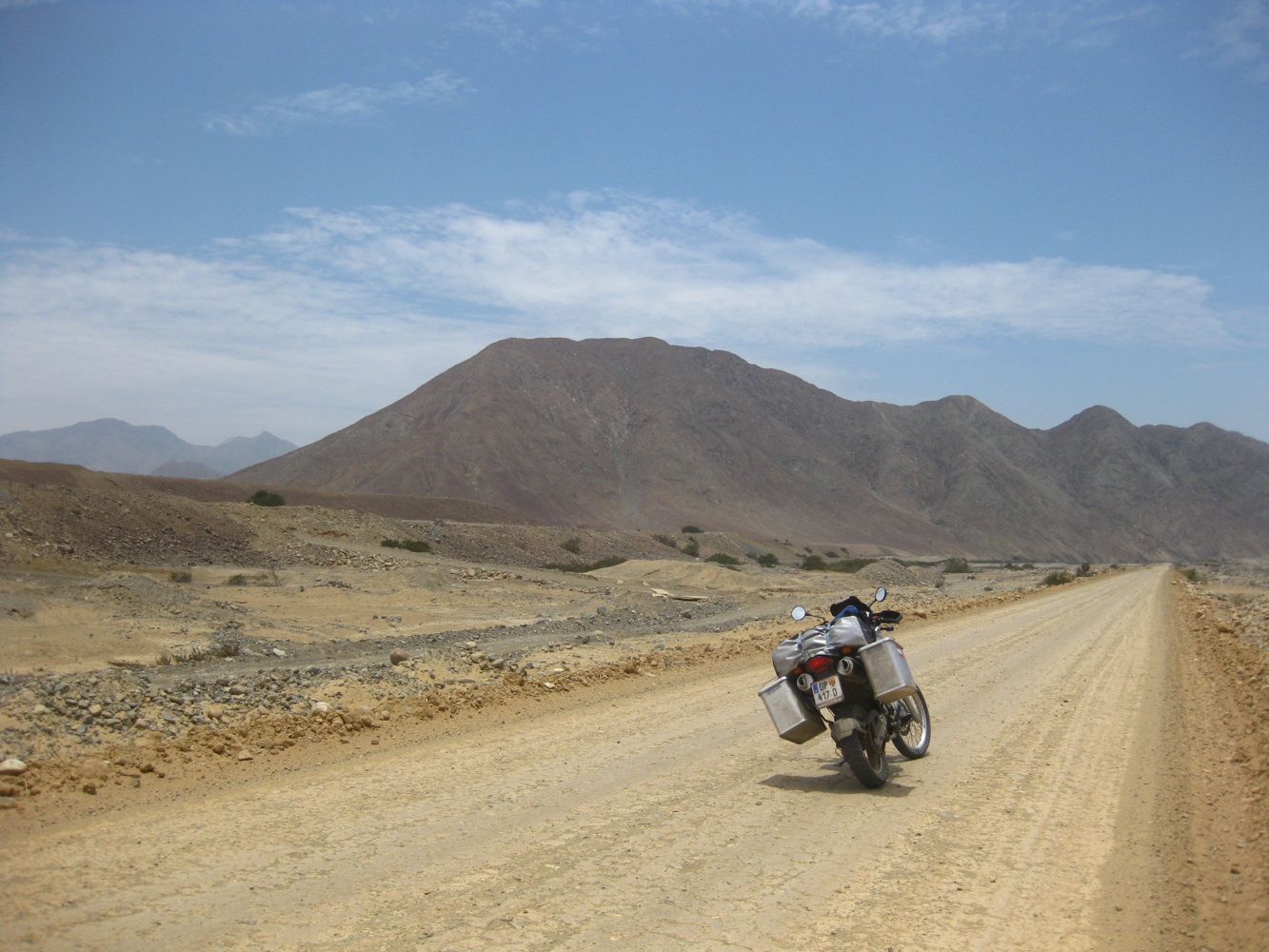
    Today I drove almost 400km only on the Pan American Highway along the coast. Mostly it is boring, just straight ahead. A constantly strong cold wind is blowing from the sea inlands.
    The scenery is not very exciting. It is a barren desolate desert, interrupted now and then by villages and cities. Near the cities there are often green fields, rice, corn, sugar cane and other stuff. Many parts of the road look like a garbage dump.

    I stopped in Chicklayo. Except for the main square, the city is not very attractive. There is a lot of traffic and as well a lot of rubbish on the streets.

    In the hotel I ask if they have a car park. The lady at the desk says: We park it back in the breakfast room.
    The entrance area is maybe 70cm wide. I look at her incredulously. Lady, did you look at my bike? It is slightly larger than the usual standard here.
    I take off the panniers, then we – a member of staff, a security guard and I – push the bike with joined forces through the lobby to the rear.
    In the next few days it becomes a habit to park the bike in the lobby or similar areas.

    22.10.

    On the way to Cajamarca I drive again bit off-road. I fall .. again. But you know, it did not happen for a long time. This time it is on the right side. The pannier is unfortunately bent in a way that the fuel cap is blocked. That would be a bit tedious having to remove the pannier each time at the gas station. So once again, a day of unplanned stopover.
    However, Cajamarca is cozy. For almost 6 EUR I get a room overlooking the main square. I read later that Cajamarca is a prosperous city. You can see it a little bit. The wealth comes from the gold that is mined in the area.

    23.10.
    In the morning I look for a mechanic who can fix my two panniers. I finally have the pannier fixed, which was dented in my crash in Honduras over a month ago.
    The man works for over an hour. The result is much better than I expected. At the end he asks for 10 Soles, about 3 EUR. I give him 20 Soles.
    I spent the rest of the day sightseeing and sending some stuff home I do not need. Hard to believe how long it takes to prepare a package. For customs in Austria I write a few nice words, that it is just stuff, I do not need on my journey.

    24.10.

    I was not able to find a good route through the mountains, so I decided to go back to the coast. But I did not want to drive back the same way that took up two days earlier. So I went off-road in one of the villages. The track is kind of challenging. I need about 3 1/2 hours for 60km. On gravel roads, the way leads up from about 1,000m to 3,000m in the mountains. Luckily, the weather is warm and sunny. I would not imagine if I had to drive in the rain here. The road clings most of the time closely to the mountains. The slopes go steep downhill. In some places the road is only carved out of the rock, only four – five meters wide. On the left side the rock is straight up and on the right side is the abyss. I don’t dare to take my eyes off the road. Always close to the mountain I drive very slowly.
    Halfway there is the wonderful town Contumazá. For a moment I consider making a stop there, but I “need“ to move on. Peru is big and I want to start in early November in Chile.

    Another reason why I need to „hurry up“ is that in mid December I met with my friend Andi in Punta Arenas. For various reasons, he needed some distance from home. We ride together for 3 to 3 1 /2 months back up to Columbia. His bike is already on a ship.

    Near Trujillo I found a hostel on the beach . The evening ends with a couple of people from the hostel in a bar. The Mojitos for just 1 EUR show their impact in the next morning as a slight hangover.

    25.10.

    The first kms I drove on the Panamericana again. The scenery did not change. It still is a barren desert. It is cloudy and the wind, as days before, is blowing strong from the west. I am sure it is the same the whole way down south.

    A few days ago Lauren and Adrian told me of Canyon del Pato, a gravel road that leads from the Panamericana to Caraz. For a long time the street leads fairly flat through a rocky landscape along the Rio Santa. Sometimes the road is wide and you can go faster. But often, you are shaken very strongly. It is quite a challenge for the material. Frequently there are some tunnels on the road. Simple tubes that were probably carved into the rock long ago. The sun shines brightly from the sky. The eyes do not have time to get used to the darkness. The rides through the longer ones of the tunnels are almost like a blind flight.

    The good thing is that the – for me – “bad” part begins only about 40 km from Caraz. The road narrows to one lane again and leads into the mountains. No matter which side of the road I have to drive, just like yesterday, I always keep staying close to the mountain and hope that no car is coming from ahead.

    Nevertheless, the Canyon del Pato is a must.

    Thank you for reading, Jürgen.
  • from 0 to 4,000

    from 0 to 4,000

    Album

    15.10.

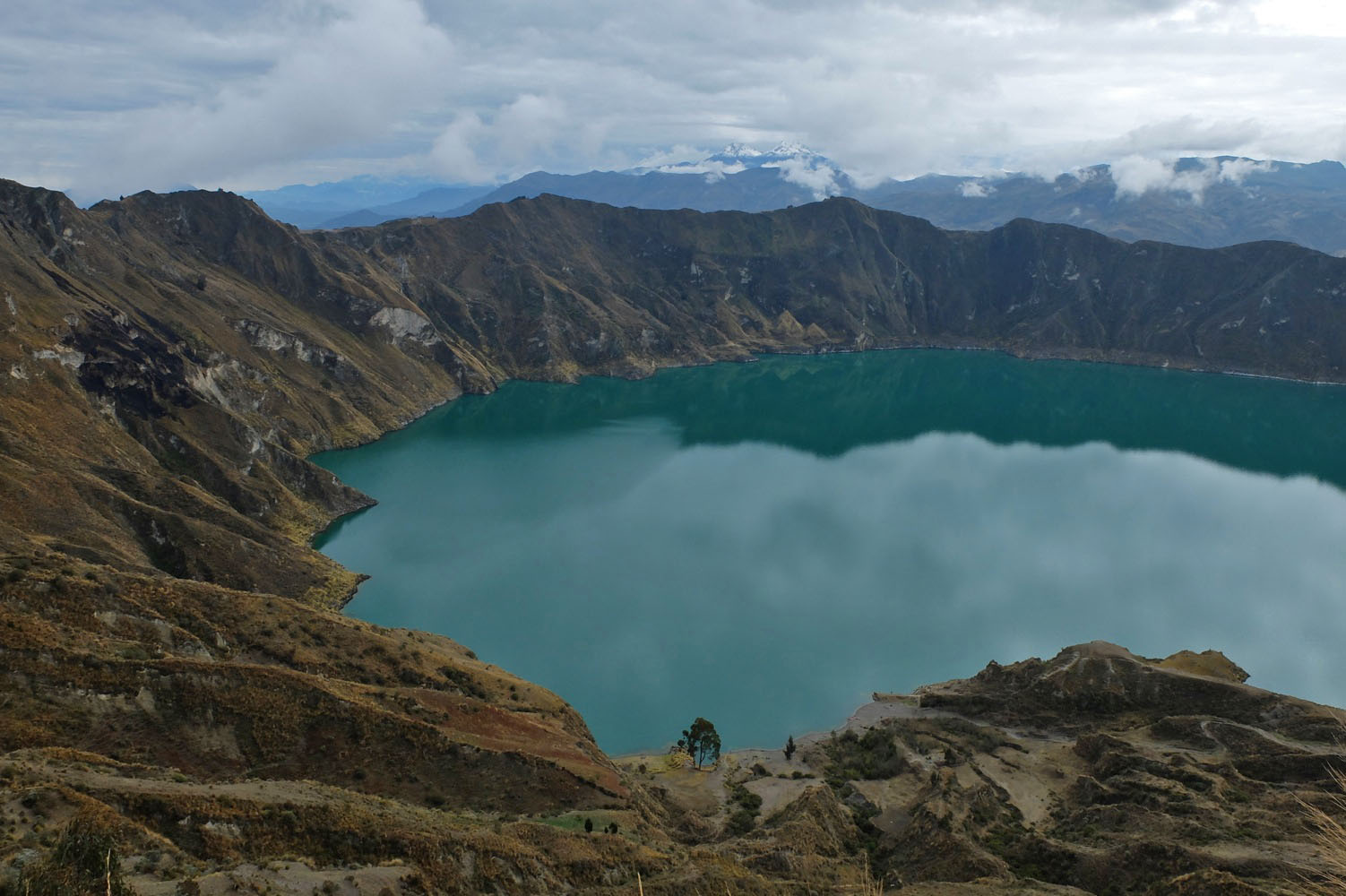
    Today’s destination, Quilotoa, is about 290 km away. “The luminous turquoise water of volcanic crater lake ‘Laguna Quilotoa’ is one Ecuador’s most awe-inspiring sight.” I read a few days ago in the travel guide. OK, so let’s go there. But what I went through on the way there is less awe-inspiring.

    I left the warmer Canoa and enjoyed the ride on winding roads through the flat area. There are only a few vehicles on the roads. It is a pleasure to drive.

    It is warm, so I stowed my warm inlays in the bag. Approximately 80km from Quilotoa it starts to rain. That does not matter, it is still warm. Maybe it will stop again soon. Just in my dreams. It is going up, 500m, 700m, 1,000m. The rain gets stronger, the mountains become higher, it gets colder. If it remains like it is, I can stand it. The water is getting through my jacket and trousers, the cold water is running into my shoes. 2,000m, 2,500m. It’s getting very cold now. I’m already wet through and through. I passed the point of no return. Slipping into the waterproof clothes would not help anymore. Still 50km from the destination. I’m freezing. 3.000m. Damn, how high will it go? I’m shaking like hell. The ice-cold water runs back out of my shoes, my fingers are numb. The heating-grips show no effect. 3,500m. Finally over 4,000m the end is found. It is still about 25km to Quilotoa. I keep my eyes open for accommodation. I do not care if I get to Quilotoa. I’m just looking for a “Hostal” sign. No signs. Finally I reached Quilotoa. I stop at the first Hostal I see. 25S the night, including food. If she would have said 100$, I would have taken the room.

    I had to enter my data in the guestbook. I can hardly hold the pen, because I shiver that much. Writing is almost impossible. My writing is like that of a child, who is holding a pen for the first time. I cannot wait to get under the hot shower. That helps a little bit to warm the body. Then I sit close to the stove, I’m still trembling. It takes a while until the heat creeps through the bones.

    There was a girl from Switzerland in the hostel. She said, yesterday there were more guests. But they fled in the morning. She is just waiting for the last bus to get away too.

    For me it is impossible to leave tomorrow. My clothes won’t dry until tomorrow. I would die driving in the cold weather. So I stay for unplanned 2 nights up here. Later that afternoon a few other guests arrive.

    Here I sit under two thick blankets, in my jacket and a hat on my head in my bed and write on my blog, 3.900m above sea level. My breath condenses.

    16.10.

    Up here no cock crows in the morning, but it is the dog of the house, which wakes the guests before 6am with loud barking.

    I walk to the nearby crater. The guide was not lying. The crater and the view of the area are a wonderful sight. I walk along the crater rim a little bit. But here it comes again, the raging palpitations. Maybe I got accustomed walking around at 3,000m, but not at 4,000. I decided not to walk down to Crater Lake.

    The small village is at the beginning of a change process. From farmers and huts towards a tourist village. A few of the hostels are still fairly simple small huts. However, there are already a few newer larger ones. The main square is new; there is such a thing as a cultural center and market, where locals sell clothes. The locals are keeping the area clean, the waste is collected. Down to the Crater Lake there is a safe walkway in work. It will be interesting to come back in 10 to 15 years to see how things developed.

    My mood today is not the best. But who should I blame other than myself? I should have dressed properly.
    In the evening a tour group of 15 people with Germans, one Swiss and 2 Austrians from Gloggnitz rush in. It is a bit strange to talk in German dialect again. There are also a few backpackers arriving. I was invited to join the German talking group, but I preferred to stay with “my” people.

    17.10.

    I leave Quilotoa early. I want to avoid a possible bad weather. But today I’m lucky, it remains sunny whole day. My toes are freezing a little bit, because my shoes are still not dry.

    The road from Quilotoa to Latacunga was so far definitely one of the highlights on this trip. For a while you stay at a height between 3,500 and 4,000m above sea level. In the far distance the Cotopaxi rises majestically into the sky. Cotopaxi, with about 6,000m, is one of the highest active volcanoes in the world. It is not possible to describe in words what nature offers here.

    To my travel companions, who are behind me: Visit Quilotoa and take the route towards Latacunga, you will not regret it.

    I’m passing Baños. Baños is known for its hot springs. As I read on the blog of Lauren and Adrian later, the volcano there erupted two days ago. The volcano is still spewing ash, which is also in the air. On the streets, people are cleaning up.

    Slowly I head back to the lowlands of the country. Macas is the destination for today. The landscape changes again. It gets green again. Forest is the dominant vegetation. During a brief stop in between I meet two Austrians again, this time from Mariazell. I had to pose for a picture, including the motorcycle and I was invited to visit them back home. They have a Hotel back home. That will probably take some time.

    I was freezing in the morning when I left Quilotoa. A few hours later I’m sweating in shorts walking through Macas.

    18.10.
    My last day in Ecuador. Again I drive on one of those mountain roads where the slopes are steep. The road is being renovated. Most part of it is already in excellent condition. Nevertheless, at some places I don’t feel that well.

    I spent the last night in Ecuador in Santa Isabel. Santa Isabel is way bigger than it has been mapped so far. It took a while and a lot of people I asked until I found the hotel. It is a bit off the center in the hills, but the view is terrific.

    Ecuador was a real highlight. I was surprised by the diversity of culture and people, the landscape and the climate. From the cool highlands of Quito through the foggy forest down to the warm coast, back up to the cold mountains where I almost was brought to my limits and further east into the jungle region.

    Thank you for reading, Juergen.

  • missed the equator

    missed the equator

    Quito Album
    Ecuador 1 Album

    08.10. – 11.10.

    The landscape stays the same in Ecuador. I’m cruising through the soft mountains.
    As you never know how long the border crossing takes, I made the first stop in Ibarra, before I went on to Quito.

    On the way to Quito I cross the equator and did not even notice it, because I was driving on some dirt and side roads. But I will have a look at my GPS record where it was.

    Quito is huge. Ovi from the “Community Hostel”, right in the old town, told us, it is about 55 km long and 15 km wide, nestled in the mountains at an altitude of about 2,800 m.

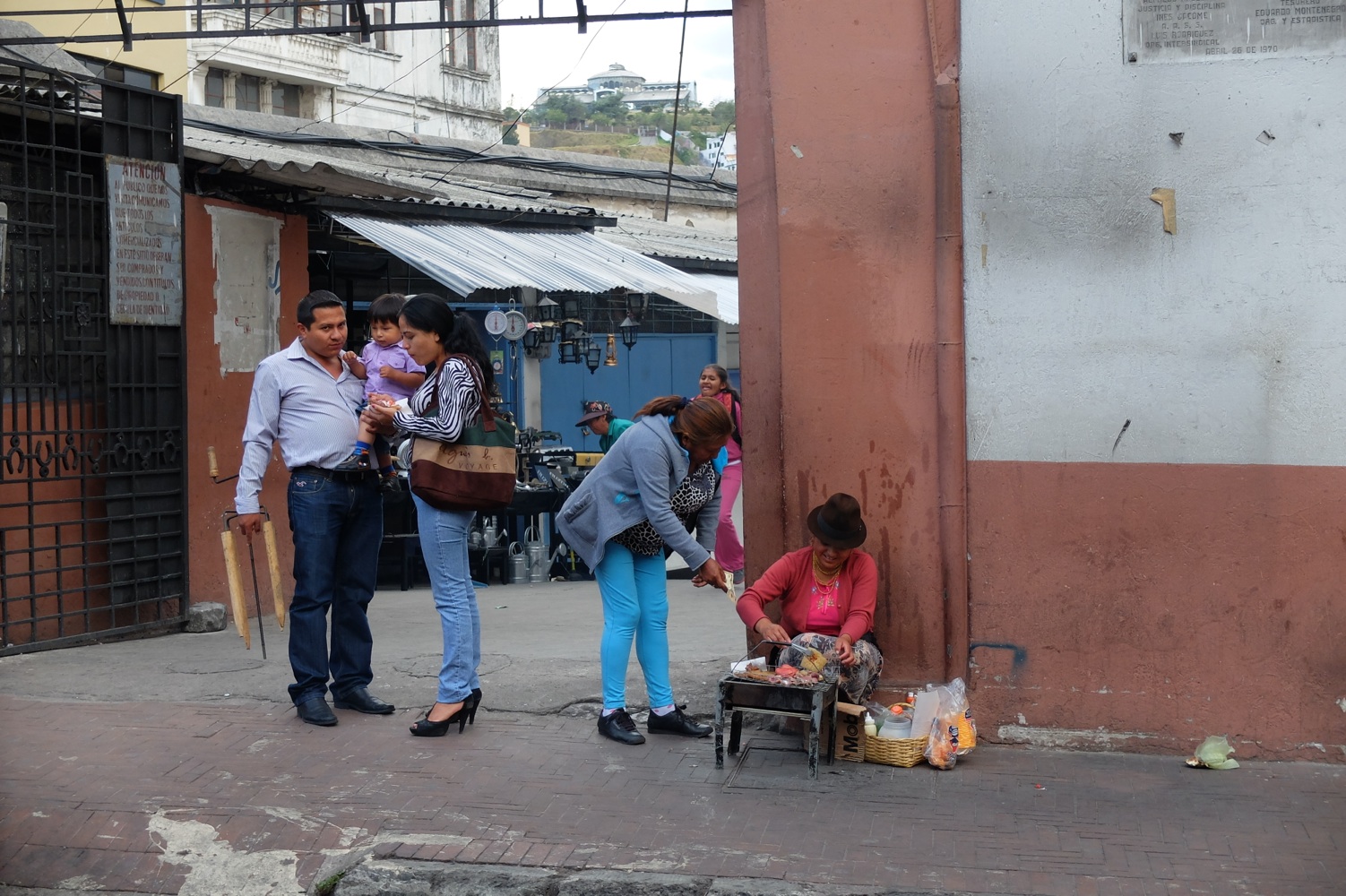
    On the streets a healer was offering his service, telling on a sign, he can heal fractures and other sufferings just with his hands. Women in traditional costumes offering textiles or frying sausage, meat and corn on small simple BBQs.

    With Ovi, who works at the hostel, a few people took a city tour. A relaxed tour to varied markets, where he tells us about specialties of the country, to historical places, a candy shop where we stock up on candy before we move further on to an arts district.

    It looks like I get used to the height. I manage several kilometers uphill and downhill without getting close to a heart attack. I take the cable car up to 4,000m above sea level. From there, you get an idea of how big the city is.
    The weather can be very changeable in Quito. In the morning the sun is shining and within a few minutes dense clouds appear and it gets unpleasantly cold and starts to hail.

    Visiting the Basilica del Vote Nacional is highly recommended. You can climb the towers through the intestines of the church. At one of the towers an iron staircase leads outside to the top. No special protection. This would not be possible in Europe. I hesitate, then overcome my fear of heights and climb up. At one of the evenings, we do a food tour with Ovi, where we tasted some snacks and dishes of the local cuisine.

    Quito was a lot of fun with the many people in the hostel, Ovi, Stephanie, Tracy, Becky, Max, Robin, Peter, Stefania, Will, Sonja, … and however all their names were.

    12.10.

    I’m on the road for exactly three months. According to the plan 25%, 1/4, or whatever are over. The good thing is, I still have 75% ahead of me. 🙂 Still no trace of homesickness. I am still happy to be on the road. Every day I encounter new things, meet new people, and sometimes there are new challenges. I met a lot of people, maybe even found new friends. (Almost) Every day a new route. You don’t have that at home, where you know every road almost by heart, where it is sometimes boring to get on the bike, because you have driven the roads so many times.

    Of course, it’s not an adventure, funny or beautiful every day. Sometimes it’s boring or you don’t like it, because the weather is bad, you sit alone in the hotel room or you can not find a connection to the people in the hostel, because the interests and the ways to travel are too different. But if someone tells me that he/she enjoys every day of a long trip, then it must be a very special person.

    Mindo is about 100 km from Quito. A small village, something like an adventure playground. They offer a lot of activities, like zip lining, canyoning, eating chocolate, watching butterflies and birds. I try the zip lining. With high speed you go from A to B on iron ropes, hanging in a harness, over several valleys. It’s a small adrenaline rush.

    13.10. -14.10.
    From Mindo I drive west, away from the mountains and hills. The rainforest seems to make his name. Although it was not raining, the clouds were hanging deep. Over a distance of about 150 km it is just foggy, sometimes I can’t even see more than 20m. After a while the moisture is going through shoes and clothing.
    Canoa is a small village by the ocean. The scenery on the way there changes drastically. It is a little warmer and more tropical. Banana plantations are along the way. Near the sea the fishery dominates. I suppose those pools located along the roads are for fish farming. Quito offers all the amenities of a big city, life in the countryside is more simple. Simple houses made of wood or stone.

    Canoa is cozy. I arrived on Sunday. It was relatively warm. The beach was full of people. Today – Monday – it is quiet, but cold. Spring just started here. At night, the sea pulls back far outside. And sometimes you’d think those damn street dogs have a consciousness, when they sit on the beach and gaze out at the sea.

    Thank you for reading, Jürgen.


  • bones break

    bones break

    Album

    Ha! Got ya! Mum, sorry for the scare. The last posts were maybe a bit boring for reading. So I had to come with a lurid headline. Personally, I had a lot of fun during the last 2 1/2 weeks, but it is difficult to transport the feelings in a written style.

    Also, from San Jose to Bogota I have been driving only about 1,000 km.
    It was time to move on again, time for more exciting things.

    04.10.

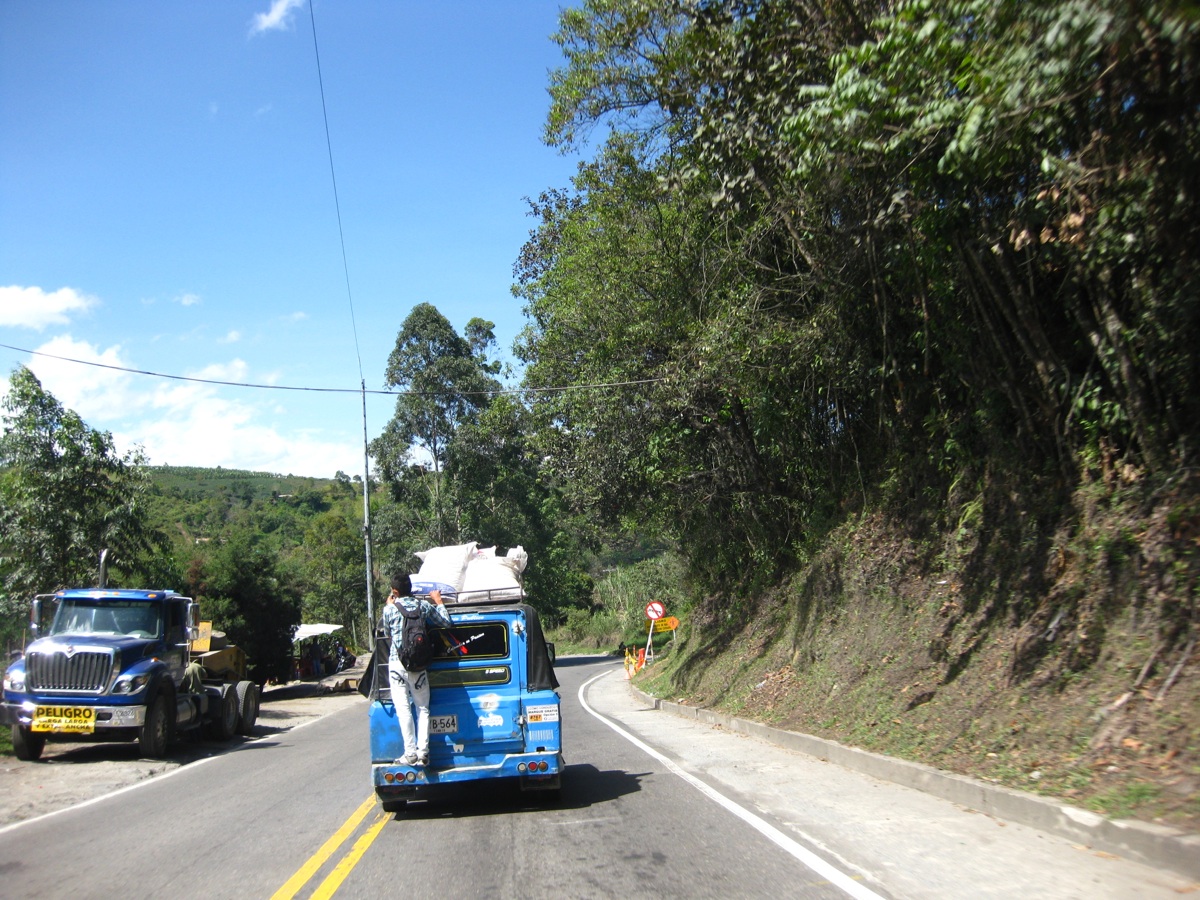
    It takes a while to get out of Bogota. The city seems endless. The traffic is dense. To Armenia I drive through steep mountains and valleys. Many trucks slowly drag down the narrow winding roads. 

    There is staff in the blind corners, I do not know whether they are paid or not. They wave to the truck drivers, who have to veer, if the road is free. With the bike I am doing better. A quick turn on the throttle and I pass the cars and trucks. 

    For a few miles there is free ride before I am behind trucks again. Such trips are very tiring to drive, dense traffic, narrow curves, always taking care. In Armenia, I go to bed tired soon.

    There are a lot of people driving motorcycles in Colombia. From scooters up to larger bikes you can find everything on the road. At a red light they all move to the front. Sometimes there are 15, 20 or more motorcycles at the front. When the traffic light changes to green, they start like bees, all at the same time, I am often right between them. It is always funny.

    Motorcycles don’t pay a toll in Colombia. On toll booths there is a bike lane where you can just drive through. I had to learn that, when I arrived at a toll booth the first time, the lady jumped out of the toll booth and waved with her hands to the right.

    I had no contact yet with the police, and so far I was not stopped. I have got a “tactic”. In the city in dense traffic on multi-lane roads I choose the second or third track. This makes it harder to be stopped. You can also hide behind larger vehicles. It seems to me the police does not really notice me. Or maybe it is simply different than in Central America, where we were constantly stopped.

    Bridges and (probably) other strategic points are almost always guarded by the military. Sometimes there are checkpoints on the road. So far I have not been stopped there too. There are sometimes three or four soldiers stationed at a distance of about 50m. Sometimes there are these bunkers of sandbags. When I pass, every single one of the soldiers is giving thumbs up sign. I do the same. I have no idea what it means. Maybe they shoot when one of them is giving a thumbs down sign.

    Maybe I will be on Google Street View. Somewhere along the road I passed one of the vehicles with the camera on the roof.

    05.10.

    From Armenia to Popayán I drive partially on highways, partly I ride on country roads.
    The GPS is sometimes kind of funny. So it happens that roads are sometimes 100m off the current position. Is it the continental drift? Some of the well marked roads turn out to be dirt roads. Some new roads are not listed, but larger cities are well signed.

    In the region between Armenia and Popayán are many sugar cane plantations. The population is predominantly black. I later read they are descendants of slaves who were brought here a long time ago.
    It’s harvest time. In the plantations workers are with their machetes at work. Road trains, with four to five trailers, transport the cane to be processed in one of the factories.

    Have I mentioned that I could eat the whole day here? On every street corner is a small shack or a bakery that offers something to eat. Lot’s of things I want to taste. It’s hard to keep the weight.

    06.10.

    Day 2 in Popayán. It’s Sunday, the sun is shining. I take my panniers off the bike and would like to visit a village about forty to fifty km away. It is recommended as an open air museum, and the locals are wearing colorful costumes.
    No chance to find the village. I have no map and the roads in the GPS are poor too. I somehow got to the backcountry. Miles and miles on stony gravel roads. There are always houses or clusters of houses along the street. I’m not sure if there has been a foreigner before. Without all the ballast it is much easier to drive the bike off-road. 20, 30, 40 km/h, you can’t go faster.

    At some point it happened. A stone hit hard on the bottom of the bike. The engine stopped, the oil light lit up. Damn, what happened? I’m about 25 km away from the city, in the middle of nowhere, on crappy roads. I stop immediately. The side stand is hanging loose. 

    I was looking at what happened. Ok, I was “lucky”. The stone has destroyed the suspension for the side stand. If the side stand is going down, the engine stops automatically – a protective function. 

    I go back a few meters and find the springs and the suspension on the street. I fix the side stand with the springs temporarily and drive a few miles further in hope to find a junction, which leads to a road back to Popayán.

    I get through a village. Everyone seems to be on the street. Slowly I meander through the throngs of people, horses and motorcycles. With my motorcycle clothes I must look like an alien. Everyone is staring at me. I ask for directions. Popayán? I have to go back. 

    Somewhere I lose my gloves too. I had them in the mesh on my top bag. I buy new ones in a motorcycle shop for 10 EUR. The people are smaller here. Size XL just fits.
    I arrive dusty – me and my motorcycle – in Popayán. Back at the hostel I try to analyze what exactly was broken. It seems the bolt, holding the plate and the spring, was bent. I must have hit the stone very hard. Hopefully it can be replaced simple.

    I think about how I can solve the problem temporarily. I need a rubber band. Where can I get a rubber band?  … I have a rubber band that I can cut to the desired length, in my pannier. Excellent! A few days ago I thought to myself: Another thing you carry around needlessly. The rubber band will do it. The stand folds up and goes back down. At least until Quito, the rubber band must do it.

    Today I had a little bad luck, but it was a lot of fun.

    07.10.

    I continue to Pasto. The landscape changes from green hills more towards brown. The mountain slopes are steep, the streets are nestled in the mountains. I don’t like these roads very much. Pasto is not really worth a visit, but that’s just my opinion. The center is clogged with cars. Exhaust gases are in the air. A large square in the center, a few old churches. Just a stopover on the way to Ecuador.

    08.10.

    It’s cold. The border is not far away. I move at altitudes between 1,500 and 3,500m. The ride is extremely fun. The road conditions are excellent, just a few cars on the road. The landscape is fantastic. It is only, you do not really know what clothes to wear. Either you freeze at above 3,000 m, because you don’t wear enough, or you sweat at 1,500 to 2,000m, because you wear too much. Within a few minutes you go from 3,000 to 1,500 or the other way.

    I got stopped by traffic police today. But I just had to show the vehicle documents. A few civilians joined them. I think they just wanted to chat and view the bike. Where are you from, where do you go, … the usual questions.
    The border crossing takes some time as usual, but is far more comfortable at about 20C, than in the sweltering heat in Central America.

    Thank you for reading, Jürgen.

  • I arrived in South America

    I arrived in South America

    Album

    30.09.

    I arrived already yesterday, as you could see from my last article. I am positively surprised by Bogota. It is a large, wide, green city. It is clean, the buildings are in very good condition.
    This morning, I walked around 15 km through the area. First up on a mountain, where I had an overview of the city. Bogota is located at about 2,600 m above sea level. On the ascent to 2,800 m my body screams, like in Zacatecas, extremely for oxygen supply. I am a lowland guy.

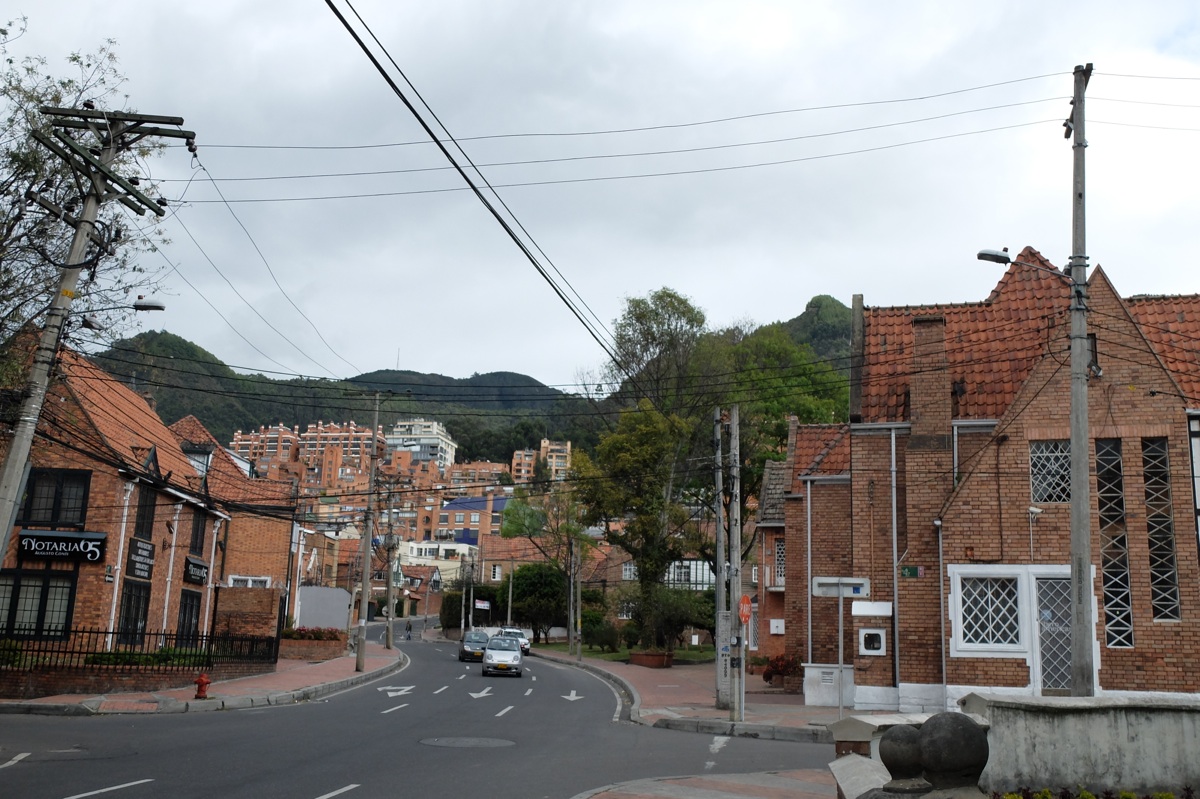
    After that, I’m walking through the city. The architecture is so different than in Central America. There are many brick buildings. Many of the districts consist of only two to four level houses. 

    After lunch I go to the airport, where I arrive around two o’clock. The next four hours drive me almost to crazy. OK, it’s very busy. The officers work furiously. One is using the computer mouse as a phone and the phone as a computer mouse. Beside me a lot of other people are waiting to get their goods.
    At the Airport I met an Australian couple, Lauren and Adrian. They are picking up their motorbike as well. Poor guys, they were even longer at the airport than me to get their bikes. While waiting we have some time to chat. They have the same goal as I and about the same time frame as I. I am sure we will meet sometimes on the way down south.
    Under observation of some people who were watching me how I took off some parts of the cover to connect the battery, I finally left the airport around five-thirty. It gets cold. No more shorts and shirts. I can put them in my bag. I changed them for long trousers and a sweater.

    01.10.

    Since the service in San Jose, the temperature light flashes sometimes. I check coolant liquid and oil. The oil level seemed to be ok, but there is not enough coolant liquid. I really want to know why that was not noticed and corrected during the service in San Jose. I want to make sure that there is no other problem and go to the BMW dealer in Bogota in the morning. Except for the coolant liquid everything is fine.

    In the afternoon I wanted to visit the old city of Bogota. But it started to rain. So I went back to the hostel, where I met Carolina who works there. From her I learned that at this time of the year it is usually sunny in the morning and rainy in the afternoon. Well, there is some work to do, so that’s ok.

    02.10.

    Actually, I wanted to leave early, so that I arrive at the destination before the rain starts. After waking up, I usually check my e-mails. Lauren wrote an e-mail that they meet up with two New Zealanders for breakfast and if I wanted to join them. Carolina also wrote an e-mail if I’m still there.

    How can I leave the city, if I have invitations from two different women in one day? 😉
    So I took a taxi to have breakfast, with Lauren and Adrian from the airport and Andi and Ellen from New Zealand.
    Lauren and Adrian are on the road for 6 months. Andi and Ellen wanted to ride only six months, extended to one year, are on the road now for 1 1/2 years and do not know when the journey ends.

    I spent lunch and the afternoon with the very lovely Carolina, who told me a lot about Bogota and Colombia.
    About the long internal war in Colombia, the daily “survival” of the people, the gap between rich and poor, the development of the city, about the dangers in Bogotá and much more.

    We end up in a café where they have – I can hardly believe it – “Krapfen”. I think only Germans and Austrians understand that. Obviously, I can not help but have to eat one. They are of course not that good, like made by my mum and grandma, but I have to say: Not bad. And the “Weibbier” and “Weibwurst” on the menu (again only german speakers understand) makes me laugh.

    03.10.

    Another day in Bogota . Today Bart and Renate arrive in Bogota  – regular readers know, the two which I joined for a couple of days to cross Honduras and Nicaragua.

    I am really looking forward to seeing them again. In the morning I go up to Monserrate, from where you have a great view over the city. Then I was walking around a little bit in the older city, to see the contrast to the area where the hostel is located. There it is mainly a residential area and business district. There were a lot of police in the center. They celebrated some high ranked person. But everything was over when I arrived there.

    At evening Renate, Bart and I celebrated our reunion, with good food and a few beers.

    It seems like there is developing some kind of social life on the road.

    Thank you for reading, Jürgen.

  • taking your job too serious

    taking your job too serious

    29.09.

    The scheduled flight to Bogota is at 11:40. Fortunately, the taxi is at the hostel earlier than ordered, fortunately there is no traffic and I’m at the airport before 9:30.

    I wanted to check-in. The lady asks me if I have an onward ticket or when I will fly back to Austria. I show her my helmet and tell her that I’m traveling by motorcycle.

    No, that is not acceptable. The entry requirements say, I need to have an exit or onward ticket. I’m pretty annoyed pretty fast and talk harsh with her. She offers me to buy a ticket. I asked her how much it costs.

    More than 700 USD. I’m about to ask, if she is crazy. She remains stubborn. I ask for Internet or a travel agency. Internet is slow, there are not travel agencies.

    I have 1 hour to solve the problem. In short: I was not able to buy a cross-border bus ticket or a flight ticket. I try it again at the check-in and just hope I would get to another check-in counter. I’m lucky.

    The other lady asks me how long I will stay in Colombia and if I have an onward ticket. I say that I’ll stay a week in Colombia and then I will take the bus to Ecuador. She looks at me, like she is not very sure, but she checked me in.
    Well I am on the plane. I’m curious what difficulties I will have to expect in Bogota.

    In Bogota no problem at all. At the passport control again the usual questions: How long are you staying? Reason for traveling, business or vacation?
    I: Transit. I’ll stay a week in Colombia, then I move on to Ecuador.
    He, friendly: What? Only a week? You have to stay longer!
    I got the stamp in the passport and could go.

    Thank you for reading, Jürgen.

  • Panama (en)

    Panama (en)

    23.09. – 24.09.

    Border crossing number 8 on my trip. Not bad for beeing about 11 weeks on the road. A guest in the Hostel told me that they want to see 500 USD in cash for entering Panama. For whatever reason. I’ve already withdrawn enough USD in San Jose to pay for the transport of the motorcycle to Columbia. I open my wallet and let the 20$ bills slip through my fingers. The officer was satisfied and stamped my passport.

    I make two stops to Panama City. David and Chitre. Chitre has the charm of a cockroach .. and it is humid. Just while sitting on the balcony sweat is running down my body. I stay at Mike’s hostel. When I looked at the homepage days earlier, I thought: Looks pretty good. But the photos are probably from the opening day. The hostel is quite run down. Mike is a nice corpulent American around the end of his 40. He is changing places between the couch behind the desk, on which he has naps from time to time and which is also his bed, to his laptop and a chair on the balcony. I’ll grab some food and a few cans of beer in a close grocery store. Since running around in the city is impossible, I sat down with Mike on the balcony. I give him a beer and listen to his story.

    President George W. Bush made him come down here to Panama. Bush started a war, led the United States to the abyss and made ​​his friends rich. Mike tells of strange guests. In between, he points out to people passing by and tells me what they do for a living. He came to Panama five years ago and opened the hostel. He wants to stay no longer than a year, hire someone who runs the hostel and move on. He still thinks about how he can do it, that the employee would not work in his own pocket.
    In the hostel there are also three local youths with a baby, two boys and a girl. Mike told me that they partied all night yesterday and have not paid for tonight. He did not see that they had eaten. Mike is worried about the baby and bought milk from the store under the hostel. Apparently they have no money. They wait for some relatives to bring money. Sometime later that evening, after another nap, Mike discovered that they had left the hostel. One of the teenagers has thrown his mobile phone against the wall. It is spread in several pieces on the floor. Mike is happy that they are gone.

    25.09. – 28.09.

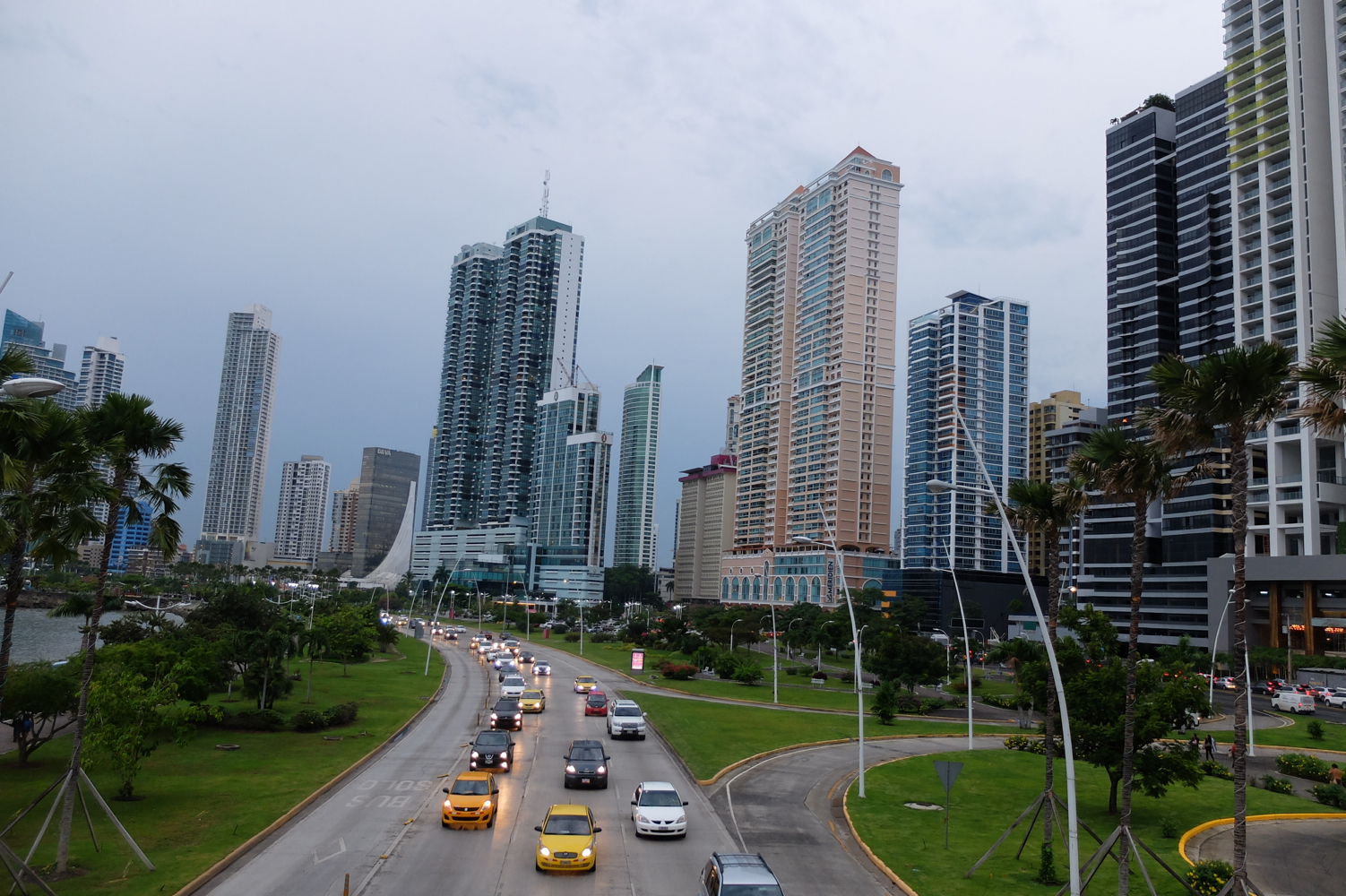
    Panama City has changed a lot since I was here more than 10 years ago. Skyscrapers jumping up like mushrooms. Banks , banks, banks … at each corner. Seems to be something like a financial center. The old town I see only at night when we go out.

    On Friday I go to the cargo terminal at the airport and drop off the motorcycle. It’s pretty easy. A little paperwork, I have to disconnect the battery and remove the mirrors, I pay 902$ and can leave. I can pick up the bike in Bogota on Monday .

    The days in Panama are fantastic. Again, I see (unfortunately) not very much of the city. The time is spent mainly with socialising. Very nice people from all over the world are in the hostel, we drink, go out and have fun.

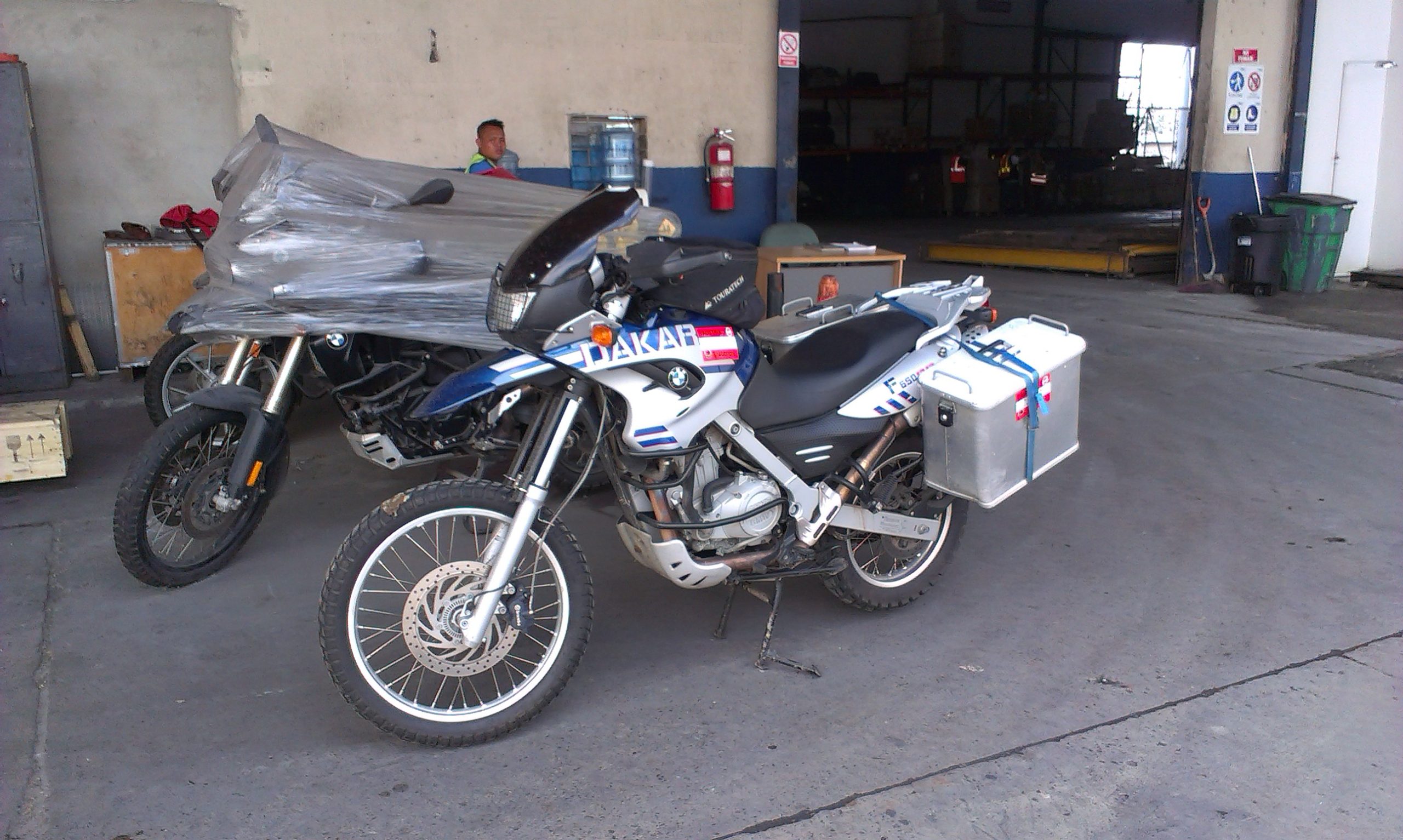
    I see more motorcyclists now. Even in Chitre, Mike told me that a few days ago another one stopped there. In the cargo terminal two other motorcycles were already wrapped in plastic. A German guy, Tobias, stops at the hostel as well. He is traveling now for around 1 1/2 years, open end. He told me that he is going with the ship to Colombia and that he had to “fight”, that they take him with them, because the boat is already full with 18 motorcycles. I am sure that I will join someone soon again.

    South America, here I come! And I ‘m really looking forward to it.

    Thank you for reading, Jürgen.
  • Costa Rica (en)

    Costa Rica (en)

    17.09. – 22.09.

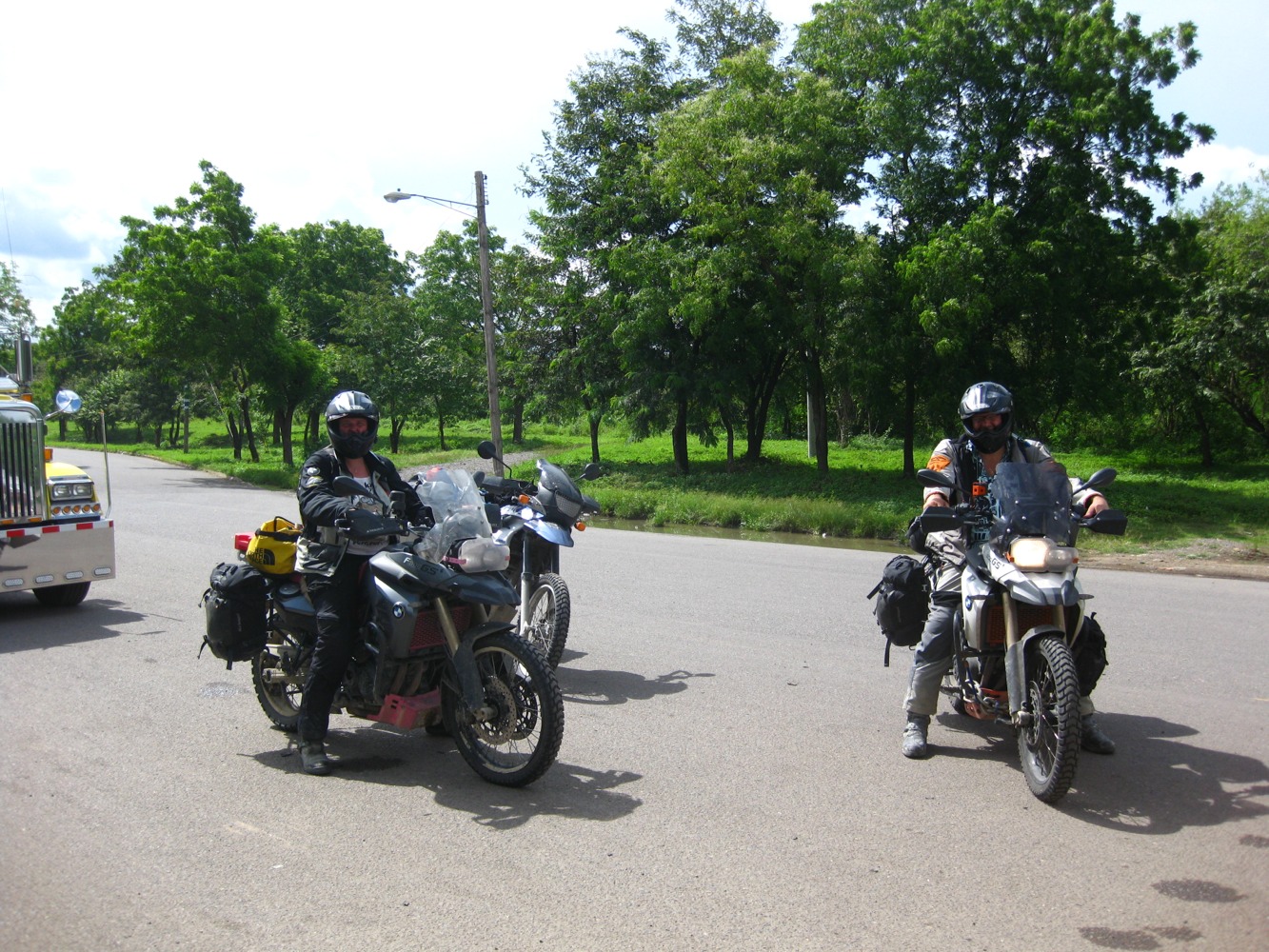
    The entry to Costa Rica took a little bit long, but again, no problems. Just across the border, we stopped at a restaurant and had a snack. Then we split up. I said goodbye to Renate and Bart and went on to San Jose alone.

    Thank you, Renate and Bart, that I could accompany you for a few days. It was an adventurous and a very nice time with you.

    Through pouring rain I arrive in darkness in San Jose. I have planned to stay in San Jose for four nights.

    There is no time for sightseeing. The service on my bike has to be done, I have to look for someone, who can have a look at my laptop and repair it if possible and I have to find a bank where I can withdraw USD.

    The service takes two 2 days. My laptop is being repaired and I found a bank where I can withdraw enough USD to have my motorbike  transported to South America. Actually, I could leave, but the hostel, Casa Yoses, is a very nice place to stay. Cool people, not many, but cool guests too. At the end I stay two more days, updating my blog and spending the evenings with wine and beer.
    It was a nice time with Mary-Ann from Belgium, who takes Thai massage classes in San Jose for a month, with Maurice, Liam, Lucas (I do not know if I wrote the names correctly) who worked in the hostel, with the older American and however all their names were.

    The owner was somehow connected to the Costa Rican national rugby team. One of the players, or whatever, sometimes had the night shift at the hostel. At one of the days they had a meeting after the training in the restaurant next to the hostel. I joined them for a beer. There are only two Costa Ricans in the national team, the rest coming from different countries from North and South America, the coach is from Peru. One of them wanted to see my bike. Yay! 🙂

    From San Jose I did not see anything. My sightseeing was limited to the ride to and from the BMW dealer, who was located about 8 km from the hostel.

    I held the first real conversation in Spanish with the taxi driver, who brought me back to the hostel from the BMW dealer. He was talking to me like to a small child, slowly and clearly. It was easy to follow him.

    I leave early on 22. Sept.  I never stayed 5 days on the same place before. I changed my plan to stay another night somewhere in Costa Rica and decided to go almost 400 km to David in Panama.

    I am driving on the Interamerican Highway. Damn it, the road is sometimes 3,500 meters above sea level. I was not prepared for that. My warm clothes are well put away in my bag. I’m freezing like hell, but I’m too lazy to unpack. Why should I? A few miles back at the coast it’s  about 32 C degrees and very humid.

    Thank you for reading, Jürgen.
  • Nicaragua, corrupt police

    Nicaragua, corrupt police

    Album

    14.09. – 16.09.

    The exit and entry from Honduras to Nicaragua took, as always, long. But again there are no difficulties. Again, the helpers were at our side. But when we tell them that we have traveled through Central America and already know how the process is, they leave us alone. To our surprise, no copies are required in Nicaragua. At the border we buy the necessary vehicle insurance for about 10 EUR. Compared to the other countries, you have only to pay for the disinfection of the bike and for the visa, the import of the bike does not cost anything.

    Our destination is Leon. But we don’t get that far. In Chinandega Bart was overtaking a car where not allowed and got stopped by police. At this time, Bart and Renate did not have copies of their driving licenses. Bart discussed for a while with the police officer, but the officer kept the license. The procedure here is like, the license is held by the police, you pay for the ticket at a bank and get your driving license back. But, it’s Saturday afternoon and until Monday there are public holidays. The next possible day to pay the fine is Tuesday. Stuck in a very unsympathetic town until Tuesday? Less of a problem for me, I could move on. Bart and Renate go to the police station, trying to clear the situation.

    I stayed with the police officer, but he left after a while. After about 1 1/2 hours Bart comes back with a local person on the pillion and has his driving license back. It is an English teacher who teaches a high ranked police official in the district. With his help, the police officer has given instructions that Bart can pay the fine and get his license back.

    Since it is already 5pm and Bart wants to thank the English teacher with a beer, I can not remember his name, let’s call him K, we decide to stay in Chinandega. K did not appear at the hotel at the promised time, so after a while of waiting we were looking for a place to eat. We sat down in a bar at the main square and had a beer when K shows up with a younger male, which we first thought is Ks son. K told us, he was looking for us and was happy that he found us. Bart paid them a beer and a soft drink. Until now, everything is still fine, but the unfortunate part is about to start soon.

    Today there is a big boxing match on television. K says he can bring us to a place where we can mix with the locals and can follow the boxing match on a big screen. Well, not a bad idea. We were running through the streets, because K had to lock a school and then we took a taxi. It turned out that the young person was not Ks son, but a student and friend. The place turned out to be a disco. I pay for the taxi, Bart pays the entry fee for both at the disco. I thought: Ok, let’s see how far that will go.

    Inside K started to talk with the waiter in a way that we were not able to follow. From this point on I suspected there was something wrong. A big plate of mixed food was ordered. The beers were brought every 30 minutes to the table. Neither me nor Bart and Renate liked the place and we decided to go, as a second plate of food was served. No way, the bill please. The waiter brought a piece of paper with a ridiculously high amount written on it. After complaining they brought us an invoice which was more than 40% lower than the first amount. We went back to the hotel by taxi. After we were paying for K and his student/friend the whole evening, K dared to ask for a little tip. Bart gave him 100 Cordoba. The arrival in Nicaragua has left a negative impression.

    The next day we continue to Granada. Shortly before Managua we were stopped again. This time it is pure corruption. We were stopped by three officers and charged with an invented misdemeanor. First they said, you have to leave at least three vehicle lengths space between each other, later it was a speed violation. We have also been stopped in Honduras a few times. Since then I only show the laminated copy of my driving license. They do not know the difference. Anyway, we each got fined with 2000 Cordoba  / 75 EUR punishment for nothing. The difference this time, the amount was issued on a white ticket. We discussed it. Everyone is talking through each other. Bart is angry. I notice, one of the officials would like to make a suggestion. Bart keeps interrupting him. Bart suggests: We don’t leave all three licenses here. We are traveling in a group. You (the police ) keep one driving license (my copy), so we can not leave the country. Renate and Bart take their driving license back and we are almost ready to go when a local person, Eduardo, stopped with his car and asked in English if he could help us. Yes! Renate had her ticket already in her pocket. One of the officers immediately hid the other two tickets. It is obvious that there is something wrong. Eduardo discussed for a while with the police and I got my “license” back as well and Renate had to return her ticket. Bart later found out on the internet that the yellow ticket is the official one and that the white papers are not valid. So it was definitely an attempt to get money from us.

    We spent two nights in Grenada. Grenada has a well-maintained historic center, some other parts of the city don’t look that nice and wastewater is discharged into the lake. Renate and Bart made copies of their driving licenses, which already paid off the next day.

    On the day of departure, we picked up our bikes from the fire station, where they were parked securely for a small amount. We drive about 400 to 500 meters without a helmet from the fire station to the hotel. We were promptly stopped. It did not help to discuss. Although it is only 7.5 EUR, it gets tedious. I want to pay, because I do not know if there is a system that extends to the border and as I’ll return to the country again. But that is unlikely. Bart suggests: If we leave the copies and we are going to be stopped again, we have no more problems, the licenses are already gone and to the border of Costa Rica it is just hundred kilometers. The yellow ticket is valid for a few days as a replacement for the driving license. We tell the officials that we put the bikes to the hotel and then go to the bank and we will be back in about 20 minutes. At the hostel we load up the bikes, let the first copy of the driving license go and drive towards the border. I wonder how long it took until the officer got suspicious. When the last stamp is on the vehicle documents, we are glad that we are out of Nicaragua.

    Thank you for reading, Jürgen.