
We arrive in the Barossa Valley on Sunday 17.03 at about noon. There are a lot of parks around the center, like a green belt. Time zone changed and we won half an hour. Yes, you read correctly, half an hour. When checking in at the hostel, the counter person gave us a tip where to find an irish pub (P.J. O’Briens). It was likely that there would be a lot of people celebrating St. Patricks Day. The pub was about 30 minutes walking distance from the hostel. We arrived there at about 4pm. The pub was already full, a band was playing and you could see that one or another person had already started celebrating hours ago. We started with a glass of whiskey and a beer. After a short time we met some people from the Adelaide suburbs. The result was a really great evening. For me it ended at about 1 in the morning with a burger at Hungry Jacks (fast food restaurant). Monday it took some time to get out of bed. It’s my third time now in Adelaide but again I did not see very much of the city. Adelaide has about 1.5 million citizens. I’m sure there is a lot to see. Maybe next time.
19.03.
Today we have a long ride of about 850 km. Today’s goal is Coober Pedy. We start early in the morning. After about 300 km we reach Port Augusta. From Port Augusta you can go in all directions. West to Perth, East to Sydney, back South or up to Darwin, directly to the Outback. From Port Augusta to Coober Pedy it’s more than 500 km. There are only five or six villages or road houses on the way. Endless wideness opens. Even if the vegetation is the same over long distances, it is very different as well. At the beginning we drive through farmlands covered in a grayish yellow, as we have seen them in the South before. Soon we could see the rusty red soil Australia is known for. The scenery is meagre and dry again littered with smaller trees and bushes. Then again we are driving through areas that look like stone desserts. They are covered with knee high round bushes. The colors change from yellow to grey to green to red.
We approach Coober Pedy in the late afternoon. Coober Pedy is an Opal mining town, if not the most known. On the way there we could see thousands of small spoil heaps, which look like small cones spread all over the area. A lot of facilities are under the earth, built into the tunnels to escape the heat on the surface. Most of the attractions have already closed. Maybe we have some time on our way back to see one or two.
Most of the rooms of the hostel are underground too. We have a beer with Martin, who runs the hostel. He looks like what you imagine of an Australian. A smaller boney fellow with a long white beard. The best times of his green Aussie hat are over, bleached, outworn and with a hole.
The next day, 20.03., Martin wants to take a photo with us in front of the hostel. “That there are not only asian fellows on the photo wall”, as he says.
We had to discover that someone took our cooling box. Ham, cheese, beans, tuna and some ingredients like chili sauce and honey were gone. The biggest loss was the rest of Toms 27$ wine from Barossa Valley. It was the second loss on this journey. My navigation device has gone after Melbourne. We stayed in a camping place in a cabin. The next day it was gone. We frisked the cabin several times and could not find it.
The ride Uluru is fatiguing. Kilometer after Kilometer straight ahead through solitude. Because of the heat there were mirages on the horizon. Road trains appear in those mirages as small points, like they come through a gate from another dimension to ours, just to pass us after a few minutes with thunder. Road trains are large trucks who tow usually three trailers, sometimes more. They can get 55 meters long. On the front they have so-called bull-bars. They stop for nothing Neither for kangaroos nor for cows or other animals. They run over everything getting in their way. We can see a lot of dead kangaroos on the road, sometimes calves and cows too, because some of the farms the highways are going through are unfenced.
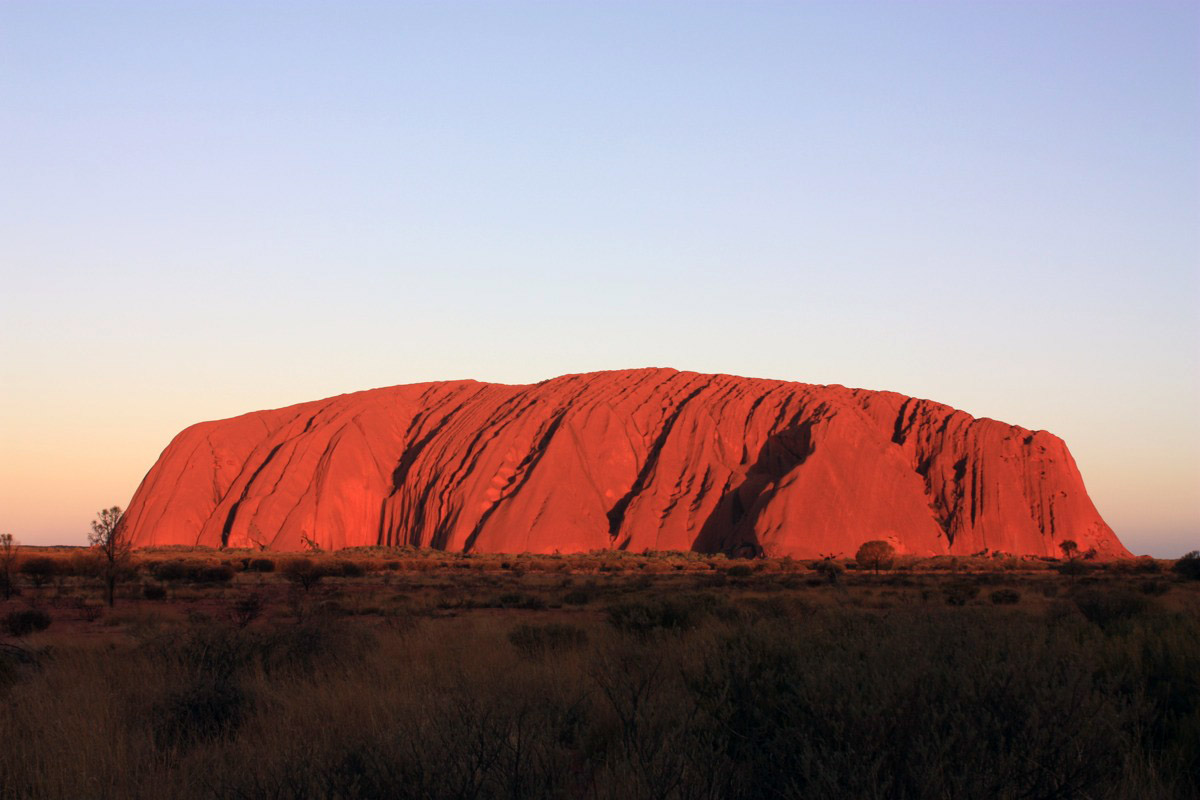
We arrive at about 4pm at Yulara. We are in the Northern Territory which is another timezone, one hour earlier than before. Yulara is the resort at Uluru. The resort is like a small city with all amenities. It’s about 20 km from Uluru and 50 km from Kata Tjuta. It has about 40 C and just 7% humidity. In the evening we drive to Uluru to see the sunset.
21.03.
Like the last days we get up early. Today before six o’clock. But as we are driving large distances for the next couple of days too, I think we have to get used to it. It is still dark when we have breakfast. In the distance you can hear how the dingoes welcome the morning howling. We arrive in time at the sunrise point. After that we start to do the walk around the Uluru. If you visit every viewpoint the walk is about 12 km long. At the beginning we are walking in the shadow of Uluru. But soon the sun is catching us, burning down like hell. Some of the walks at Uluru and Kata Tjuta are closed from 11am, when temperatures get over 36C.
And then there are the flies. They are small but “aggressive”. Searching for some moisture, hundreds of them attack our sweating bodies. It is very annoying when they get into nose and ears. Insect repellent did not help in any way. A lot of visitors have a hat with a net. A good investment. I try to keep away the flies with a stick with leaves. Wolfgang is putting a white shirt around his head. And Thomas almost killed himself with repellent. It takes about 2 1/2 hours to walk around Uluru. Park authorities recommend to finish walks before 11am and then not do exhausting things. We spend the afternoon with eating, watching TV and writing the blog.
In the evening we go to Kata Tjuta. You can see the round rocks from a far distance and can watch them long when approaching. It seems a bit like they are filled with life, like some kind of animal that fell asleep …
Thank you for reading, Juergen.