
15.05.
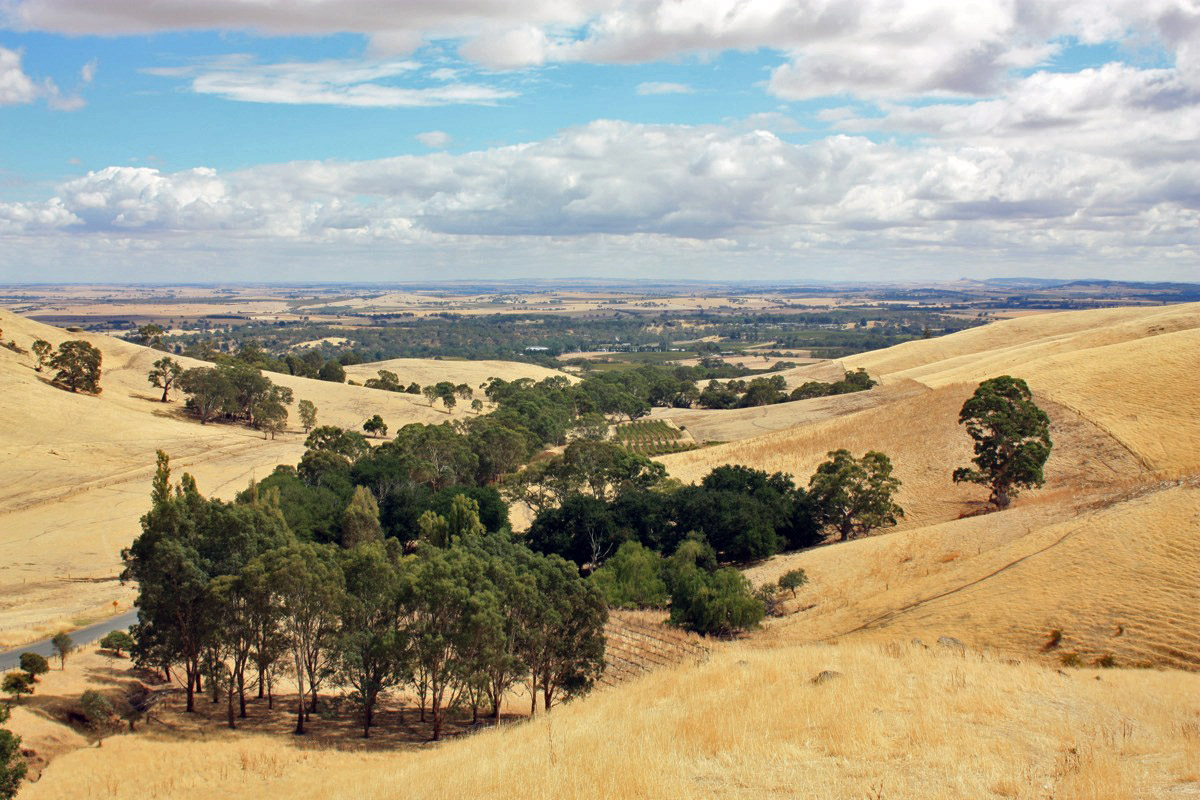
We are leaving Robe and heading to Barossa Valley. While the population in south east Australia is very dense, we are driving kilometer for kilometer through empty regions, often just straight ahead. The navi says “38km tip the next waypoint”, then “Stay 65km on this street”. We pass a few small villages on the route. For about 300km it’s mostly the same. The vegetation is getting dry again. There are huge plains on our route. Mainly there are farms. You often can see cows and sheeps grazing. I ask myself, how can they get full with this meagre food. Maybe they need the huge land, to get the animals full.
The landscape is colored in a grey yellow. You can see signs everywhere that fire is strictly prohibited. Sometimes you can see traces of recent fire, like it could be seen close to Sydney. A denser population starts again as we get closer to Adelaide.
We are in the Adelaide Hills now, and visit “Hahndorf”. Hahndorf is one of the first German settlements in Australia and a tourist attraction. From a Brauhaus, to butcher and German bakeries you can find a lot of things here.
Attaching the Adelaide Hills is the Barossa Valley. It’s called the most known wine production region in Australia. The most known wine made here is the Shiraz. We are driving through the villages Willamstown, Lyndoch and stay in Nurioopta for two nights. A lot of known wine makers can be found here: Penfolds, Lindemans, Wolf Blass, … .
On March 16th we want to drive through the Barossa Valley. We stopped at the visitors center of the winery Jacob’s Creek. But about noon is to early to start with wine tasting. So we are moving on and visit different villages and several lookouts in the area. Early afternoon we stop at the winery Wolf Blass. We try different wines, which is free. For each wine, they tell you about the origin and the special taste of the wine. To taste the 140$ and the 170$ wine you have to pay 15$. The service personnel says that it was a dry year. There was only 25 millimeters of rain. So they expect a meagre crop. On the other side it means higher prices for the wine. When a quick but heavy rainstorm passes the whole personnel was excited.
Wolf Blass has only screw-caps on its bottle. They explained that cork can absorb environmental impacts when growing and release them to the wine again. It is very expensive to get high quality cork. And it’s less likely the wine will get bad with screw-caps. During a testing phase they filled wine from the same casks to bottles with cork and to bottles with screw-caps. They opened them six years later and they said it was like drinking two different kinds of wines.
Tomorrow we are heading to Adelaide.
Thank you for reading, Jürgen.