
06.02.
A new country on my trip. We crossed the border at Villazón. At the border, crowds of people are spilled out of a lot of big buses. Long lines are at the counters. People who are traveling with their own vehicle have their own counter, so it does not take too long.
We are on the road for a long time and it is already late afternoon. In Villazón we are trying to get money at an ATM, which does not really work. So we decided to drive on to Tupiza and try it there. A few miles beyond the town, we had to stop at a toll booth. USD is not accepted. So back to the village. No Bolivian money in your pocket, we may have to go back to Argentina. Finally we were able to get Bolivian Bolivar on an ATM and it also spits out USD.
07.02.
In Tupiza we meet Steve (Stephen) again in the hotel. This time not from the States but from Canada. He is traveling for a few months in South America. Well, we do not have to remember many different names.
From Steve, we learn that the route from Tupiza to Uyuni is not very good. The last few days it rained a lot. Steve was told by someone who had taken the route by bus, that they were traveling 14 hours instead of 6 hours and that the people had to push the bus from time to time. Because of my problem with the radiator we stay on safe roads from now on and decide to go to Potosi with Steve and then to take the paved road to Uyuni from there.
The route to Potosi is quite well developed and we had a good ride. We are traveling at about 3,500 m above sea level. It is surprisingly warm and the weather is with us. Only on the mountains there are often big black clouds. About 40km before Potosi I see on my GPS device that we are going right into one of the black spots. I was just hoping that we would arrive dry. 25km before Potosi, we are suddenly in the cold rainy weather. Within a few seconds there is a temperature drop from about 25 degrees C, to about 5C. It hails, the fingers are freezing, the visor fogs up. I am counting down every single kilometer.
It is a strange spectacle to drive into the city .. dark and depressing. Only a few kilometers before Potosí is the Cerro Rico. They predominantly mine silver there. The big heavy loaded trucks of the mining companies mess up the road and drive slowly on the winding road down the mountain. Through a maze of streets we enter the city center, they are clogged with cars and people, everything that has legs seems to be on the road.
In the evening we go out for dinner. On the main square, the kids are throwing water balloons. We were told this has to do with the carnival and seems to be a tradition. The groups of children do attacks and counter-attacks. A woman is making a good business in selling the balloons out of a barrel to the children.
08.02.
In the morning Andi and I are walking through the streets. We got into a huge market, which stretches over several city blocks, north – south, east – west. You can find everything. Over a distance of several hundred meters people sell their fruits, vegetables, meat, … . There is food in abundance. In between there are always stalls where they cook meals. We have lunch .. chicken, beans something, pasta, tomato salad.
We did not dare to try tongue .. of whatever animal it was.
Potosi has a long history of silver mining. The Casa Real de la Moneda, the Coin Museum, is one of the most interesting museums I have visited. There you can learn much about the history of coinage in America. From embossing coins with hammer and seal on to electrically operated machines. There are various devices that have been used for the production of coins. In the museum are three huge wooden machines, made in France, for the printing of silver that were driven by donkeys or slaves (but that was not told).
In South America, the Spaniards have produced the same coins in different countries. To distinguish them they engraved the year and a sign of the place the coins were produced. In the case of Potosi, it was the letters PTSi, placed over each other on the coin.
We were told by the tour guide that the $, Dollar or Peso sign, is the result of the letters S and i.
09.02.
Mike from the states joined us the evening before. He is almost 30 years old and spent a couple of years in the Army, including a year in Afghanistan. Steve, Mike, Andy and I continue together to Uyuni.
You approach Uyuni from a mountain. The valley is endless. In the great plain, the city Uyuni looks really tiny. Clouds empty themselves in huge curtains of water in the vast plain. From time to time flashes are striking down to the ground. And again, I’m standing there and I can not get enough from the spectacle that is offered by nature.
In Uyuni, our group is getting larger again. In front of our hotel, we meet Taylor from Seattle, who is traveling with his 650 GS. He has been traveling for about 5 months now and just has about three weeks left.
10.02.
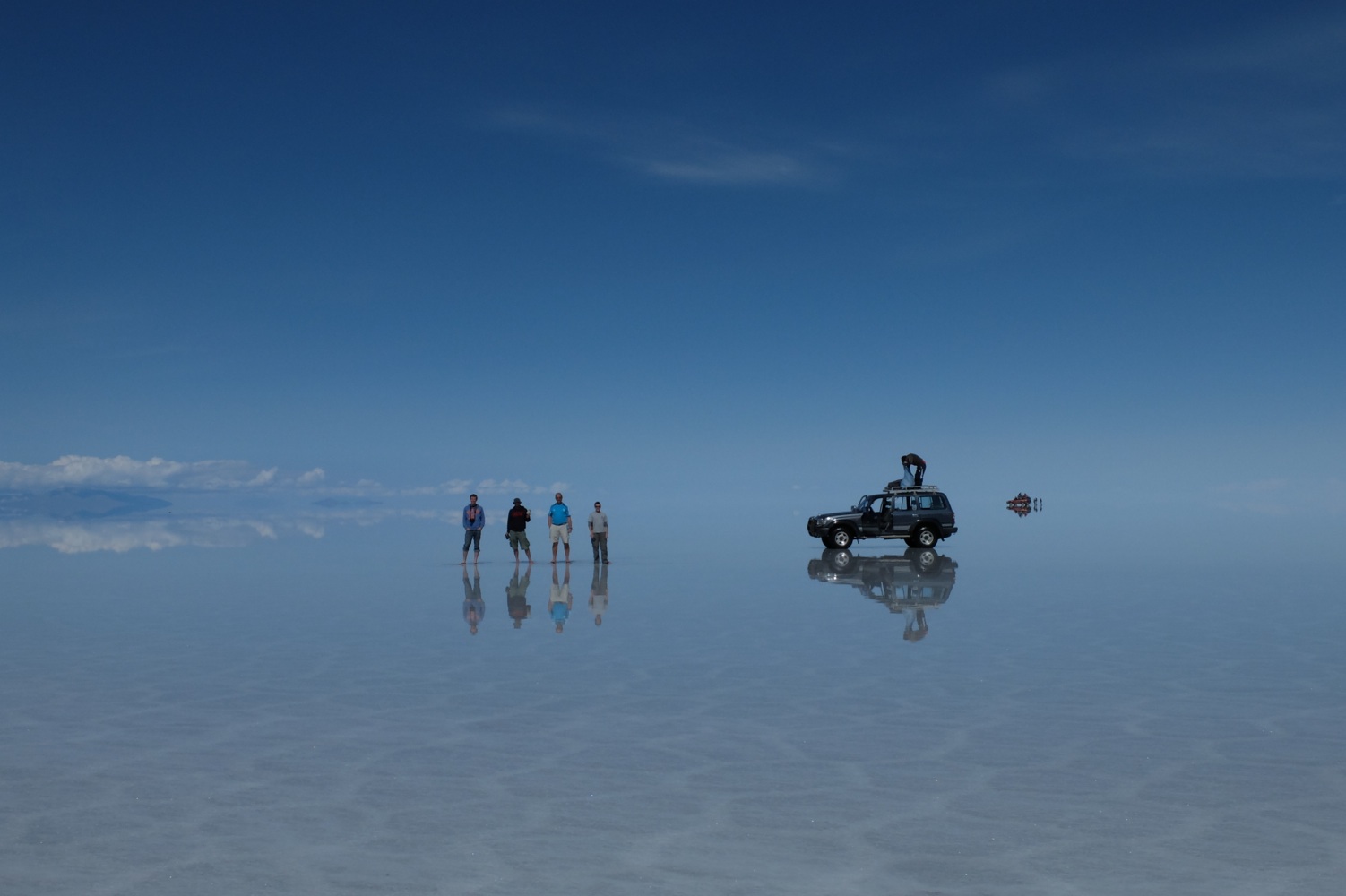
A ride on the salt lake with the motorcycles is not possible – it would be possible, but we decided not to do it – because it is rainy season and the lake is covered with water at the moment, usually it is only a few centimeters deep. We rented a Jeep in the morning at a tour organization and went out to the lake. It is a special kind of experience. Further out on the lake, sky and lake seem to merge. The reflections give the impression as if you were floating in the air.
From Wikipedia we know that there is a lake under the salt crust, but we were not aware that the salt crust is barely thicker than 10 cm. We are far from the shore, when we notice a hole and then the thickness of the salt crust. And after we have seen the first hole, we recognize all the other countless smaller and larger holes. Our driver told us that every now and then a vehicle collapses, but it has not happened to him yet.
Steve leaves us and moves on further north in Bolivia. Taylor, Mike, Andi and I go to Chile on the Ruta 5. Our destination is the border town. The road is very rough. Somewhere I lost my side panel that I fixed, apparently not good enough on my bag. I did not install it, because I constantly have to fill water in my cooler. I go back and find it. I must have dragged the side panel probably a while after me. It is no longer usable and I left it where it was. Last but not least the BMW emblem on the other side panel falls off too..
I had no problems with my bike until I came to Patagonia. It is truly a rough area. It seems my bike is falling apart.
Just before the border to Chile, Taylor was crashing hard on a sandy spot. I did not notice it, because I had the leadership and Taylor was third. I was a bit ahead and thought at first that they had stopped to take pictures of the beautiful landscape. When I saw them running around wild, I became aware that something was wrong. Taylor was really lucky, he did not get hurt. But the left side of his motorcycle was badly damaged. His pannier was completely torn. The instrument panel, indicator, windshield, mirrors … all damaged. But the motorcycle is running. What a luck.
We stay in the border city in Chile. It is like an outpost, an old western town. At some point trains stopped here, but the train station looks like a graveyard. The buildings look very run down. Surprisingly, inside they are very nice. We have only Bolivian money. Late in the evening and far from the nearest ATM, the lady in the hostel knows how to make a business.
11.02. / 12.02.
Border – Antofagasta – Caldera – La Serena
Again many many kilometers through the Atacama. In a way I like it and at the same time „hate“ it, this desert.
13.02. – 15.02.A stopover in La Serena. The weekend is approaching, concerning my radiator, we cannot do very much. We decided to stay until Sunday and to drive the last few kilometers to Santiago. My radiator is leaking very much now. Every day I have to fill in more and more water, it is almost 1/2 liter now.
After a boozy evening with Mike and Taylor, Andi and I sat together in the hostel for a long time with other guests.
I said it before, sometimes there are hostels where you feel extremely comfortable. This one here is a residential house with a large garden. I think they have a maximum capacity of 20 beds. A few beds in the house, the rest in bungalows. There are large palm trees in the garden, friendly owners .. a place to hang around for a while. It is as if you are „at home” .
Thank you for reading, Jürgen.